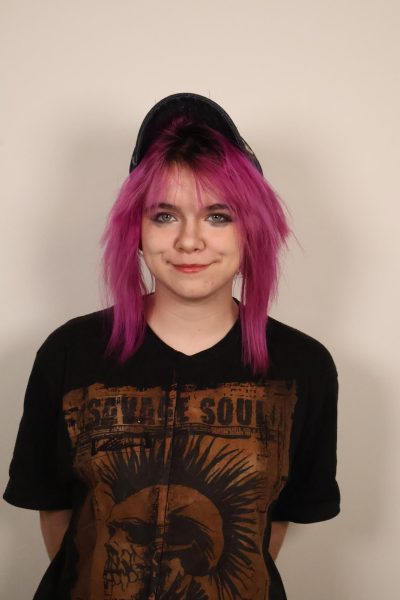








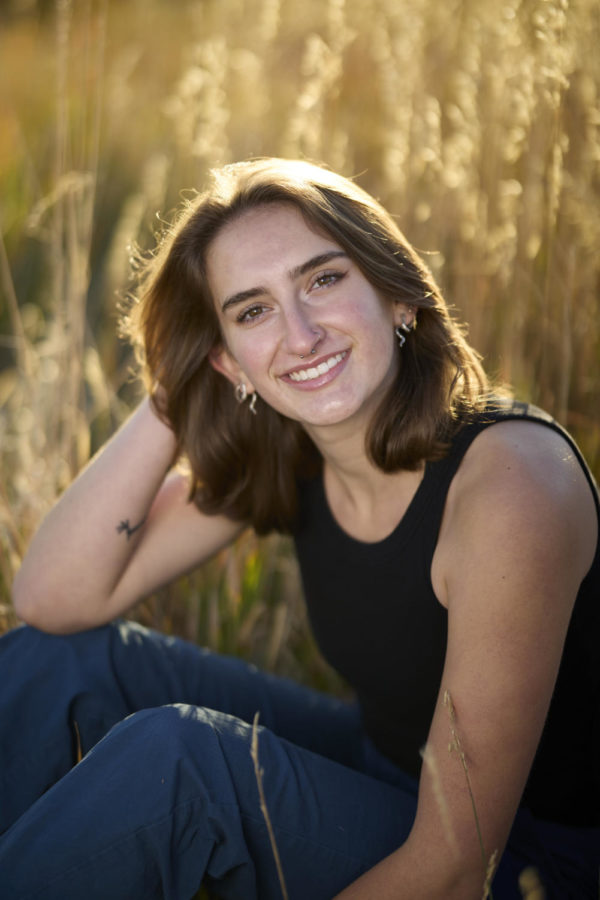






Carla Papazian (10) has always been an outgoing, social person. Constantly enthralled by the world around her, she finds joy with the people who understand her best.
Three years ago, however, that key part of her personality came to a sudden halt.
“I started feeling sick around January of 2023, and I went to a doctor when I first started showing symptoms,” Papazian said. “That doctor said it’s probably just stress, and I need to drink more electrolytes and water.”
With hopes of relieving that stress, Papazian and her parents took a trip to Mexico for her 13th birthday a few months later.
They quickly realized that much more was going on than stress.
“I went to Mexico, and I could barely walk more than 10 feet away without feeling like I needed to pass out or needing to sit down,” Papazian said.
While in Mexico, she became increasingly desperate for answers, initially thinking that she had some sort of anemia after doing some Google searches. Hoping to solve the issue, she had her dad go buy iron pills, to no avail. Papazian had no choice but to see a doctor while on vacation.
She finally got her first answer.
“You definitely have some sort of anemia. But it’s not normal anemia. So when you get back home, you have to go to the doctor immediately,” he told her.
When Papazian got home, she urgently went to the doctor where she got a full work up to figure out what was going on. Her hemoglobin was a stark 2.6 g/dL in contrast to a normal level for a Colorado resident at 14 g/dL. She then rushed to the ICU of Children’s Hospital Colorado in Aurora where she stayed for the next few days.
“I had just turned 13, so in my brain I hadn’t fully comprehended, like, ‘Oh yeah, this is going to completely change my life,’” Papazian said.
A bone marrow biopsy showed that Papazian had aplastic anemia, a condition in which bone marrow stops producing new blood cells. This leaves patients with extreme fatigue and makes them extremely prone to infections. In some cases, it can be fatal.
The doctor delivered news that devastated her.
“You need to get out of school,” he said to her. “You can’t go to school anymore because you’re going to get sick.”
Her life as she knew it completely changed. Papazian had to withdraw from most social aspects of her life as she knew it. She felt like she was placed in a bubble. Being an outgoing person, this took a toll on her.
Papazian had to choose between going through immunosuppressive therapy, or starting the long process of a bone marrow transplant. With no matches in her immediate family, Papazian opted for immunosuppressive therapy.
Amazingly, it worked.
“I completely got better in like eighth grade, and I was off all medications. I was enjoying life,” Papazian said.
Finally, Papazian was able to start living like a normal teenager. She was finally able to go to school, attend parties with her friends, and it just felt like everything was normal. Papazian was able to enjoy her whole freshman year. Only, she didn’t think this sense of normalcy would be so short-lived.
“In August 2025, all of my counts started going down. I really started feeling it.” Papazian said.
Papazian started going through treatment again with a bone marrow transplant being her only option. A donor hasn’t emerged yet, and even when one does, it won’t be close to over.
“There’s a 90% chance of me surviving, and there’s a 10% chance of me dying,” Papazian said. “And that 10% is from either complications or a graft versus host disease, because it attacks the body and your immune system goes all crazy,” Papazian said.
Because of Papazian’s treatment, she’s had to withdraw from all of her social outlets.
“I used to always hang out with friends and always be that type of person,” she said. “When you get a bone marrow transplant, you have to be in practically perfect health. So it has basically put me in a bubble.”
While this is extremely hard for her, she’s been able to start to share her journey through her TikTok page.
“I got tired of explaining what it was to all my friends, and how it got undermined,” Papazian said. “Whenever I told somebody they never knew what it was and I was like, ‘Oh my gosh, this is infuriating.’”
Papazian has struggled to get people to understand just how severe her disease is. She’s not treated as though she has a life-threatening blood disorder —the same way that someone with leukemia would be treated. She’s treated as though she has a simple deficiency, easily treated with a supplement.
“When I’m like ‘I have aplastic anemia,’ Nobody knows what that is. They think ‘Oh, she’s like, going through something simpler, oh, it’s not important’’’
“I really show people like, oh, it actually is living with something like this, and having to go to the hospital so often, and being stripped away from school, and having your only social life be hospital nurses. It’s hard.”
Currently, Papazian is spending most of her time at the hospital, logging into online school every day, and interacting with her friends through the screen on her phone. Patiently, she waits to start the process of her bone marrow transplant. If the treatment is successful, she’ll be able to return to school and leave her bubble.
“I can go back to school, and I can start doing things,” she said. “It’s like the start of a new life.”