














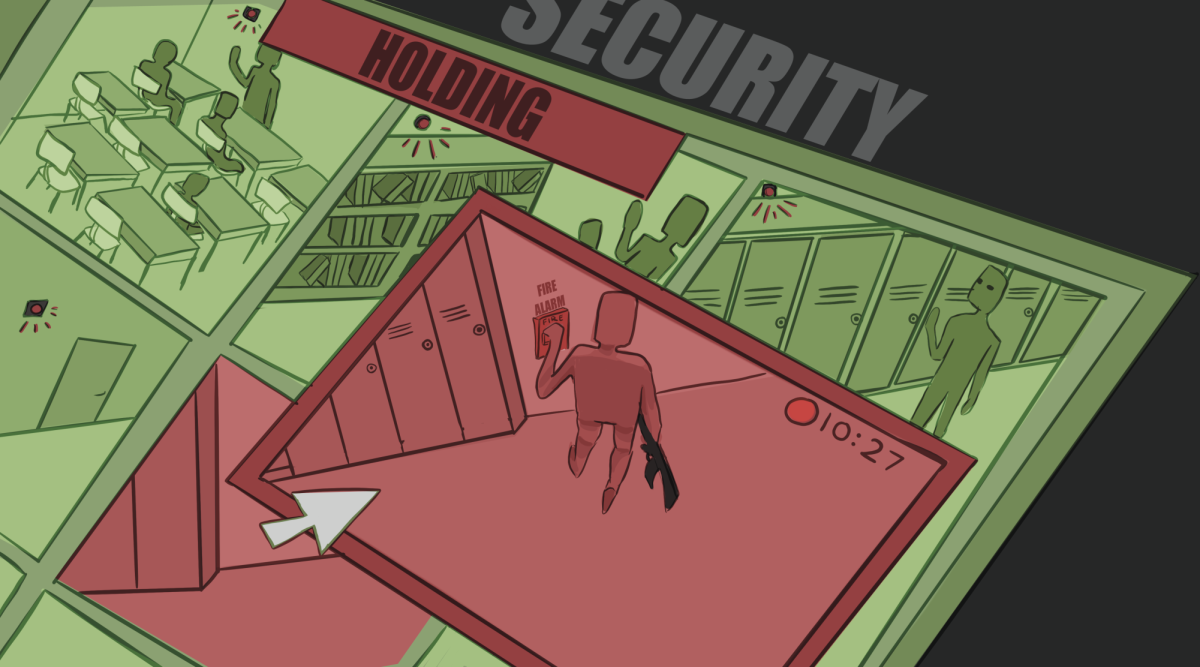
On March 24, 1998, an eleven-year-old student at Westside Middle School pulled the school’s fire alarm. The student then proceeded outside, where, along with another student, they fired shots at students and staff leaving the building.
Four students were killed.
To prevent incidents like this from happening at Monarch, former School Security Advocate (SSA) Steve Brown implemented the procedure of going into a “hold” when the alarm goes off before evacuating. On October 10, 2025, this practice was ended.
A hold is one of the commands inside of the Standard Response Protocol, which is recognized nationally by both schools and law enforcement agencies. During a hold, students remain where they currently are in the building, keeping the hallways clear and allowing for staff members to move around the building quickly. It is often used during medical emergencies to enable first responders to move quickly through the building to reach an emergency faster.
According to Monarch Principal Greg Doan, “[Monarch was] asked to change the procedure to be in compliance and match what all other schools were expected to do,” Doan said in a statement to The Mix. “We were the only school to my knowledge in BVSD that was doing a “hold” prior to the evacuation.”
Furthermore, in recent years, both the Parkland Shooting and the Santa Fe Shooting had a fire alarm go off because of smoke in the air caused by the ignition of gunpowder. In both of these cases, the fire alarm activation caused mass chaos and could have caused harm to students or staff.
The Colorado School Safety Research Center released guidance specifically around this, advising teachers to be extra vigilant while evacuating their classes. The hold is a great extension of this policy by shifting the responsibility to security, who have a much greater ability to quickly search the building and its surroundings for any threats through the use of cameras and specific information on where the alarm originated from.
According to a study by the National Fire Prevention Association, approximately one person dies per year in school fires, while 39 are injured. In contrast, a Washington Post gun violence in schools database shows 34 deaths caused by school shootings in 2024.
The policy didn’t just protect us from school shooters, it also prevented evacuations in cases where no emergency was present. For example, in early October, two separate instances occurred where the fire alarm was triggered when no emergency was present. According to student-facing documents obtained by The Mix, both activations were caused by a student pulling a pull station. Because students and staff were trained to wait for the PA announcement to evacuate, it allowed administrators time to realize that no actual emergency was present and saved valuable class time while also preventing mass chaos during the school day.
Even if there is a fire or other emergency in the building, having the hold allows administrators to give the best possible guidance to students for how to safely evacuate. For example, if a fire ignites in the back of downstairs A hall, administrators could advise students and staff to use a different path to leave the building.
Despite the change occurring to increase consistency across schools, BVSD shouldn’t default to removing security to create consistency. It would be better for students and staff at all BVSD Schools to implement the change across the district instead of removing it altogether.
Most importantly, the hold created a sense of safety and security; even if the procedure lacked the ability to prevent such incidents, the hold acted as a form of “security theater”. Security theater is defined as having security measures that create a sense of safety, while not doing anything to achieve that. Some common examples of this are random bag searches at events and TSA Random Screenings.
The hold was one of the many small things done at Monarch to help keep students and staff safe. While it may never end up being necessary, it also wasn’t causing any inconvenience and was arguably preventing larger inconveniences. By removing it, the district is solving a problem that never existed.